Dense Discovery: from zero to nearly 40,000 readers who found their own way in
Every issue of Dense Discovery opens with “Hello discoverers!”, followed by a quote, a piece of artwork and a background colour that changes each week. Scroll down, and you’ll find the week’s finds sorted into sections, from Tools and Books to Numbers and Polls. It’s a magazine-like newsletter with a lot of personality, read by nearly 40,000 people every week.
What’s surprising is how it got there. No ad campaigns, no growth hacks, no big launch. Just one person in Narrm (Melbourne, Australia), Kai Brach, hand-picking links and sending an email every week for over a decade.
We spoke to Kai about building Dense Discovery from zero, the systems he’s built on EmailOctopus to keep it running, and why a weekly email is still worth sending.
For a bit of an intro, how did the idea for Dense Discovery come about?
DD started as a digital 'in-between' for my print magazine Offscreen. I was publishing an issue of Offscreen every three or four months and wanted a way to stay in touch with readers more often than that.
The first version was called 'The Modern Desk'. Issue 1 went out to a humble 460 subscribers on 29 January 2015 – a handful of interesting links from around the web, once a week. I kept it going under a few different names for several years.
Then came COVID, and the print magazine became too difficult and costly to continue. The newsletter, meanwhile, was relatively easy to manage. So I changed the name to Dense Discovery, redesigned the format, and started treating it as a proper curatorial project that might also generate some income.

Kai Brach, creator and publisher of Dense Discovery.
What did your list look like in the early days, compared to the nearly 40,000 readers you have now?
I feel strongly about people opting into an email list, so rather than dumping my magazine readers’ email addresses into a new list, I cross-promoted it where it felt natural and started from zero instead.
Luckily, my readers are very supportive of my work, so by the time issue 1 was ready in 2015, several hundred had already signed up.
Everything since has been organic. Besides a handful of cross-promos with other newsletters, I've never done any marketing or invested in growth. It's mostly word of mouth, which I'm quite proud of, because that attracts far more engaged and loyal readers than any ad ever could.
I should also mention that I regularly clean the list of inactive subscribers. Without those purges, my subscriber count would probably be two or three times what it is today. 😉
You've been with EmailOctopus since 2020. What were you using before, and what prompted the switch? Roughly how big was your list at the time you made the switch?
Like so many others, I started on Mailchimp. Before it got acquired and 'enshittified' into a convoluted marketing dashboard, it was the industry go-to. When it became too frustrating and expensive to use, I went looking for cheaper alternatives.
First stop was Mailblast, using Amazon SES to dispatch emails. Good experience overall, though the app hasn't changed much over the years. It seemed to be run by one person (maybe still is?), so feature development and support were basic at best.
I moved to EmailOctopus with around 20,000 subscribers. The more professional feature set, the SES support and the overall friendly brand image appealed most to me at the time. I also really liked the idea of supporting a small independent company based outside the US that isn't reliant on Silicon Valley money to grow exponentially.
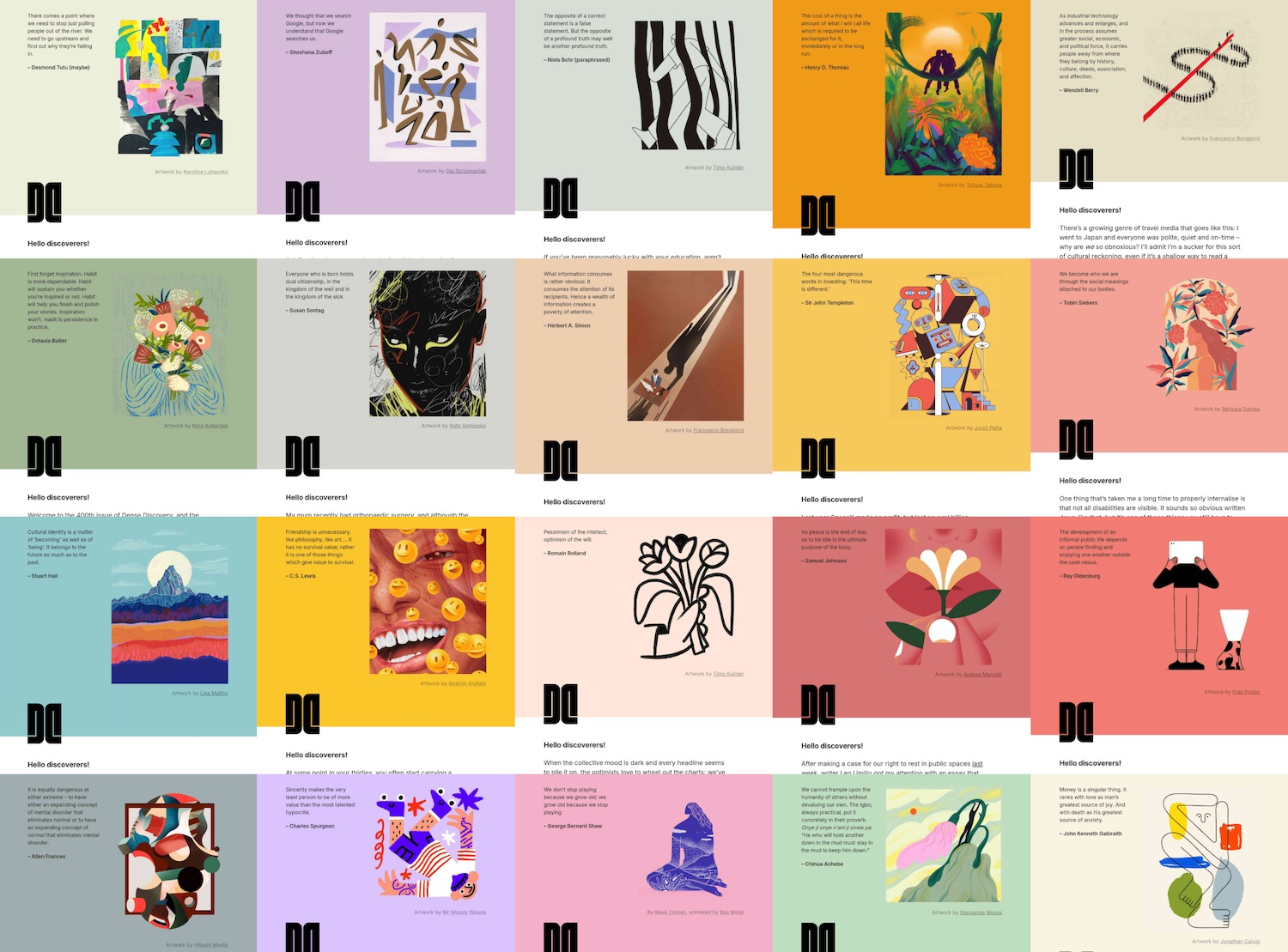
Dense Discovery issue headers, each pairing a quote with its own artwork and background colour.
What's driven the bulk of your growth over the years? Were there any specific moments, tactics or EmailOctopus features that gave the list a real boost?
No ‘explosive’ moments, I'm afraid. It really has been a slow, organic project that gathered more and more readers along the way.
There are few things that make me more uncomfortable, work-wise, than a hard sell. So I rarely promote DD, and I don't have the budget to run ad campaigns anyway.
The visual design of each issue is really considered. What's your creative process for putting an issue together each week?
I use tools like Raindrop.io and Readwise.io to dump all the apps, articles, books and various other links I come across. Every week, I go through the different categories and pull together an interesting mix.
Something a bit unusual about DD is that I use a custom-built template that I've tweaked and refined over the years. Every issue is put together in VS Code, like a website, and then I paste the code into the plain-text editor in EmailOctopus to publish. All the image assets are self-hosted.
Can you tell us about Friends of DD, your paid membership program?
I have a paid membership program called Friends of DD. Instead of doing what most paid newsletter programs do, I deliberately don't offer extra or paywalled content to paying readers. Instead, they get a range of perks that make their experience of DD more unique.
That includes the ability to hide the ads in the newsletter, discount codes only Friends can see, and the bit I'm most proud of – access to the DD Lounge, a custom-built community platform where Friends can discuss each issue and meet other readers from around the globe.
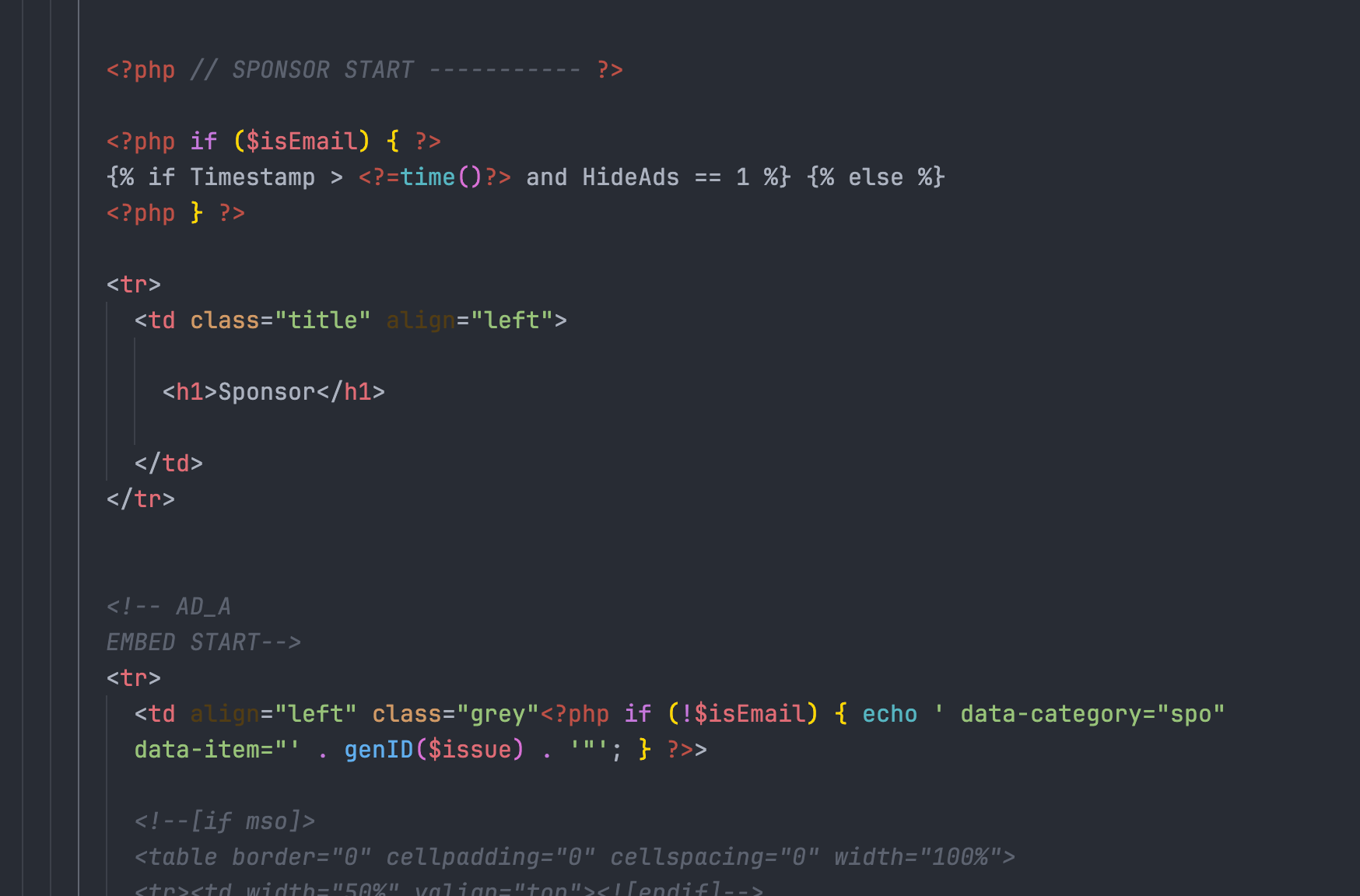
Part of the newsletter template – the sponsor section, with a condition that checks a HideAds value.
A big part of the Lounge is being able to bookmark items directly from the newsletter. I spent quite a bit of time building a login method that lets Friends click a little plus (+) sign next to any link in the email. That automatically logs them into their Lounge account and adds the item to their bookmarks. So they can build a collection of favourites straight from their inbox, no logging in or extra clicks required.
Friends can also contact guest contributors through a form that sits inside the Lounge, so they can email the people I feature to ask follow-up questions or just connect.
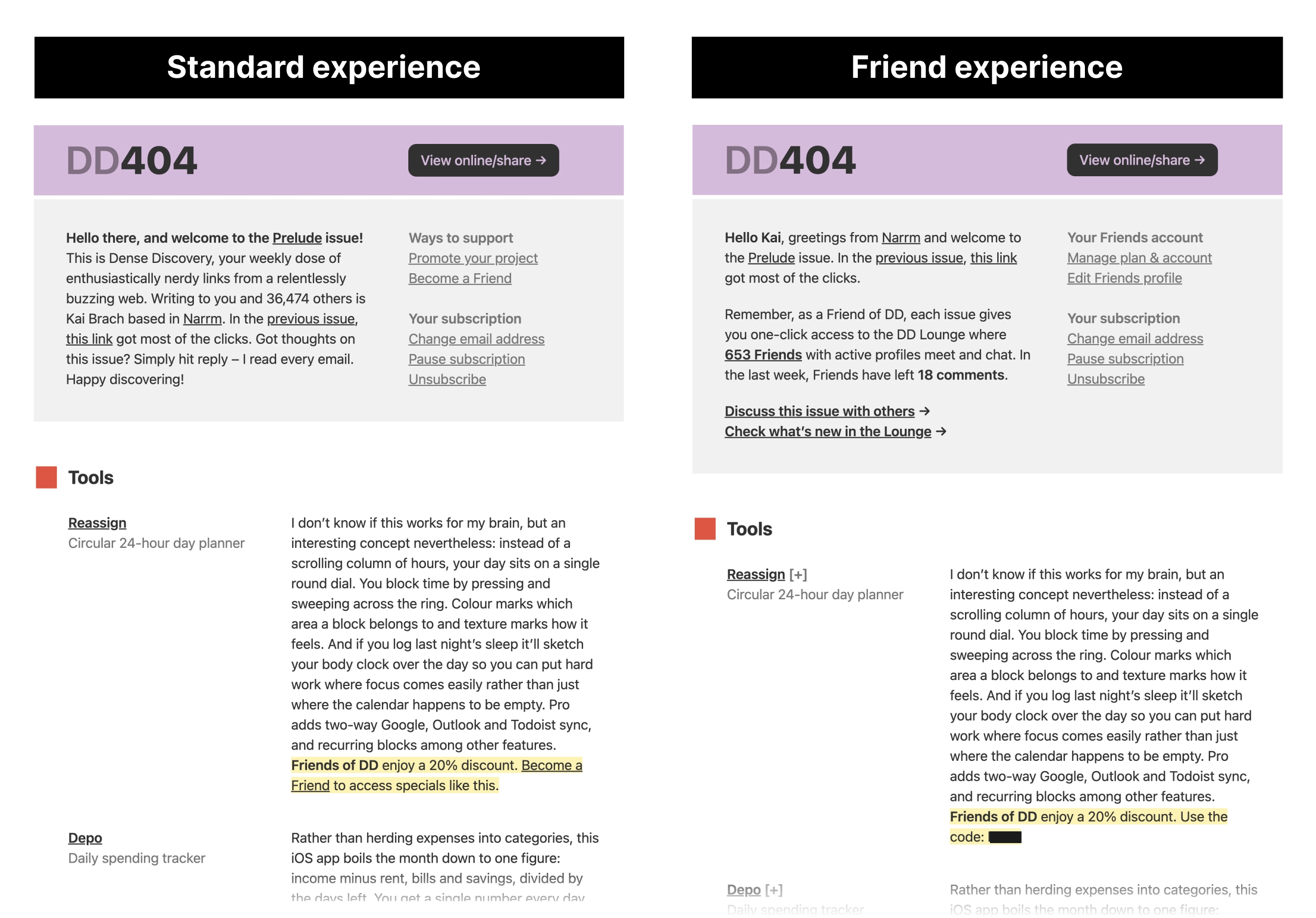
The same issue, two ways – the standard version on the left, and the Friends version on the right with a personalised greeting, [+] bookmark links and a discount code (hidden here).
How did you achieve that technically with EmailOctopus?
I make use of EmailOctopus's custom fields to store a unique login token and some other info. With that, and EmailOctopus's excellent conditional statement feature, my template essentially creates two versions of the same newsletter – one for the common reader and one for Friends of DD.
Every reader gets pretty much the same content, but Friends get more options to engage with it and take it a step further. They also get to meet other readers in the Lounge, which makes it a real community.
Can you tell us how you manage your subscriber list?
I put a lot of effort into keeping the list as clean as possible. I actually built a custom backend for it, making heavy use of EmailOctopus's excellent API, which lets me keep track of each sign up as it comes in.
A few of the things it does:
- Records (and later deletes) IP addresses so I can block individual spammers.
- Runs a risk assessment on each email address submitted – looking at the domain, the format and how it fits alongside surrounding signups. Then, gives it a score that either allows, challenges or blocks the signup.
- Lets me delete or flag individual subscribers with a single click.
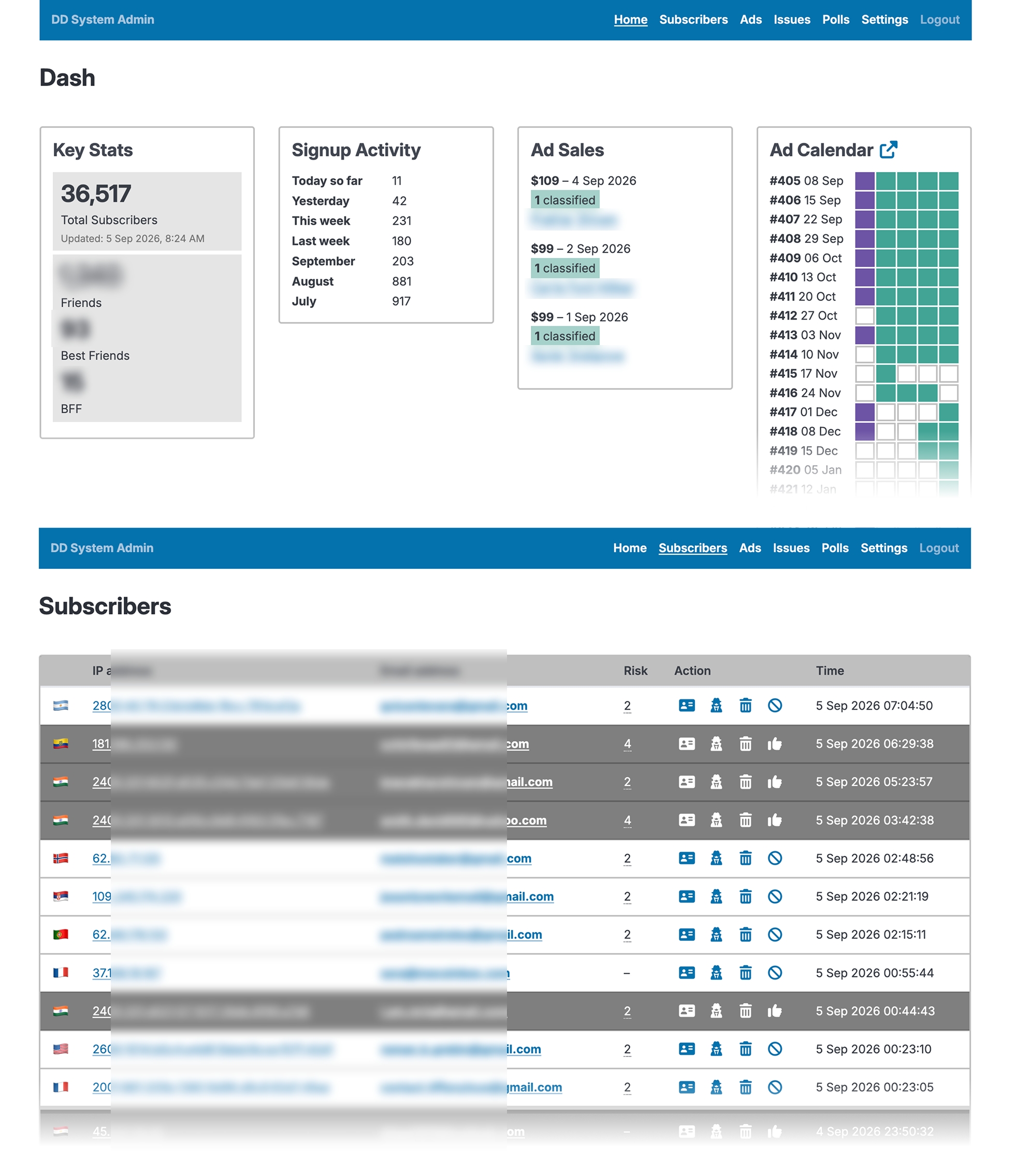
Kai's custom admin dashboard (personal details blurred), showing subscriber totals, sign-up activity, and a risk score for each new sign-up.
For example, I can tag a subscriber as 'suspicious' if I can't tell whether they're real or spam. That triggers an automation where they have to click through to my site and complete a little maths challenge to prove they're human before they're fully subscribed. Of course, it doesn’t completely solve the problem of fake subscribers, but it makes it harder.
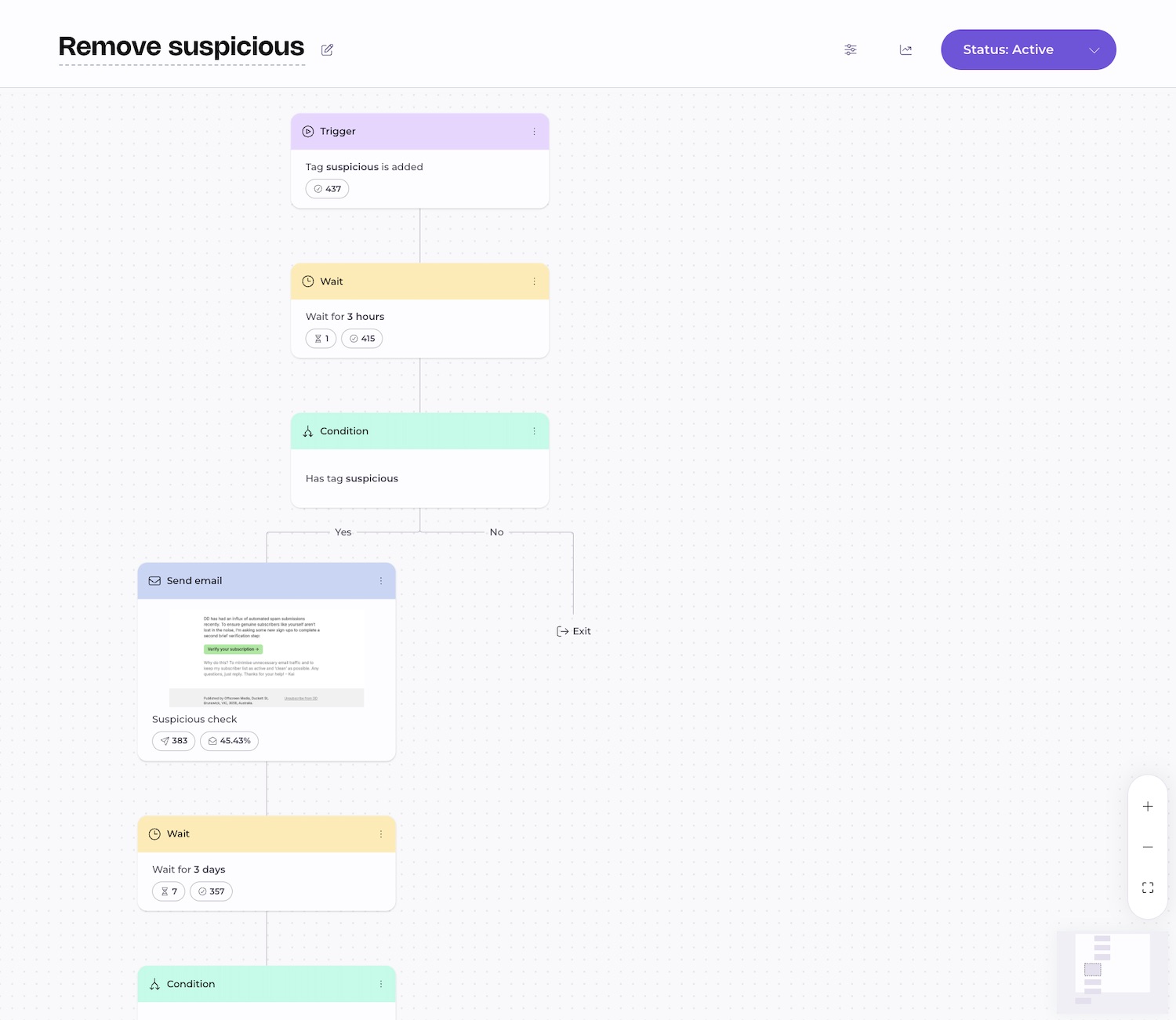
"Remove suspicious" automation in EmailOctopus with a Contact tag added trigger. This automation checks if the contacts initially tagged as suspicious prove they're human by completing a math challenge. If they don't, they're unsubscribed via the automation.
What's your approach to sponsorships/ads within the newsletter? How do you decide what to feature, and how does that fit with the "indie, no attention-merchant" ethos on your website?
A good question, and something I still struggle with regularly, especially now that so many apps are quickly vibe-coded to piggyback on the latest hype and don't necessarily align with the quality and craftsmanship I want DD to be associated with.
Finding fixed-price sponsors and advertisers can be difficult. A lot of big advertisers now expect algorithmic advertising, or per-click or affiliate deals.
I think the strong ethical stance of the publication and the topics I cover in my intro do some automatic pre-filtering of ad customers. Then I assess each booking individually. There have been a couple of occasions where I cancelled and refunded a booking because I strongly disagreed with the politics of the people running the service. That's not always easy to determine, so sometimes I get it wrong.
I'm more selective with sponsors because, in a way, they 'open' the issue, and the word itself suggests they support what's being presented. If there's too big a gap in values, it feels jarring.
The classified section is a little looser. Like traditional classifieds, it's meant to have a more open format, maybe even a bit wacky. It's affordable enough that people can advertise their pet projects or weird hobbies.
You've got a full public archive of past issues on your website, and also promote the newsletter on social media. How do you think about the newsletter as reusable content? And does knowing issues will live on that way change how you write or structure them?
Absolutely. The archive is one way for me to hold myself accountable. I can always edit and correct a mistake in the archival version, but its longevity means I'm adding to a growing body of work that's there for everyone to see.
A reader once described DD as “a little magazine via email”, and as someone who created a collectable print magazine in the past, that notion strongly resonates. I love having the full catalogue online. It adds credibility and accountability – it shows this isn't an infrequent side gig, that I've been doing it for literally hundreds of weeks in a row.
It's also really interesting to see how culture and ideas (and my own thinking and writing) evolve over time. Looking at pre-COVID issues feels weirdly nostalgic.
What does a successful issue look like to you, day to day? Beyond that, are there any bigger milestones or results – growth, engagement, awards, you're particularly proud of?
My favourite issues are the ones that evoke a heartfelt response - readers replying directly (which I encourage), sharing the issue on the socials, or posting in the DD Lounge. So the measure is probably resonance, when something I write or share makes someone want to add their own view or thoughts to it.
I keep an eye on the campaign stats too, but mostly to see which links readers find most interesting and whether anything unusual or unexpected is going on. Like that time a YouTube shortlink caused Gmail to throw a tantrum. Ironically!
As for what I'm most proud of is having a sizable readership that's been with me for close to a decade and still opens the newsletter every week. Some of them have even become paying readers, even though what lands in their inbox afterwards is largely the same newsletter. (Thank you, Friends!)
A few years ago, I started saving kind, heartfelt responses in a folder I call 'confidence boost'. There are a few hundred emails in there now. Some are a few lines long just to say thanks for the weekly inspiration or utility. Others are real, quite elaborate stories about how DD has affected them – career changes, difficult conversations with friends, getting conservative parents to vote differently.
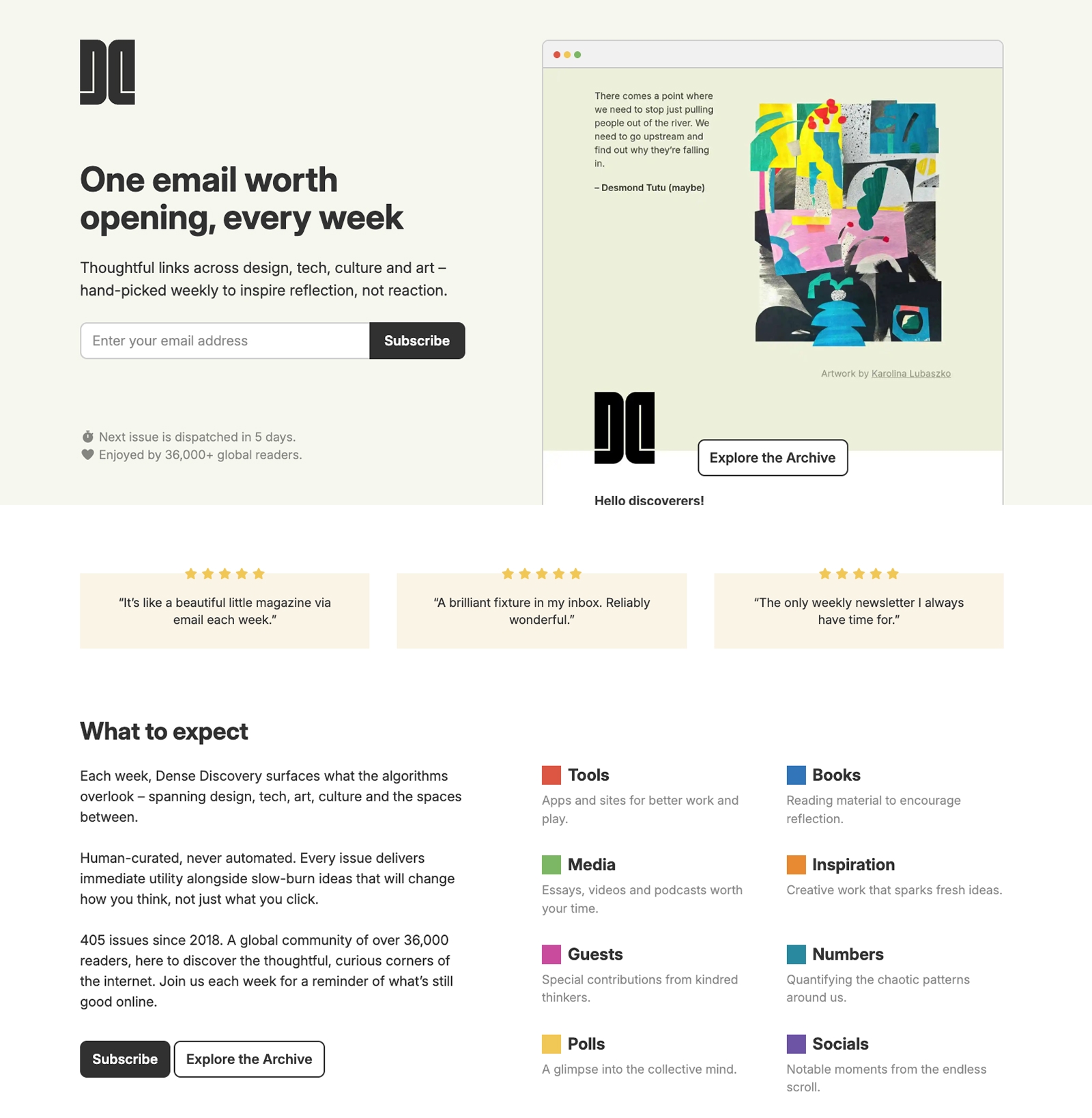
The Dense Discovery homepage, where readers can sign up and see what to expect each week.
What has building a sustainable business around a weekly newsletter taught you about what email can actually be?
I feel incredibly lucky that I get to do this. I call it 'learning in the open', because the weekly ritual of exploring the web, reading articles, looking at art and design has shaped my own thinking as much as that of my readers. And I get to do it as my main job. (I still do a bit of freelance work on the side.)
I don't know how the email format will change in the coming years (AI seems to compress, mangle and remould everything it touches, it’s becoming a weird intermediary for everything), but if the past is anything to go by, there will be a core group of people who keep connecting with other people over this stubbornly simple, old-school format.
Where do you see Dense Discovery heading next based on this?
Maybe I'll just quote what I wrote in my 400th issue of DD:
“You'll be relieved to hear there's no roadmap to '10x' this. For the foreseeable future, DD will remain nothing more than a humble email, sent because I still enjoy sending it, to people who – somewhat improbably, 579 issues in – still want to read it. For now, that's still the whole strategy: find good stuff, put it into an email, hit send, repeat.”
Check out Dense Discovery to subscribe or browse the archive.