
Alex Baia: on growing a list of 15,000 subscribers, one joke at a time
Alex Baia started his newsletter in 2016, early enough to see what happens when you build an audience on social media alone. But you never know with the algorithm. As Alex puts it, "One day, the algorithm loves you. The next it serves you papers, and you're standing there with a broken heart, listening to 80s breakup ballads by Journey and Air Supply."
So he grew his mailing list instead. Nearly 15,000 subscribers later, Alex writes humour for The New Yorker and McSweeney's, consults on email marketing for DTC brands, runs writing workshops, and publishes Comedy Bizarre – a publication teaching funny writing. The newsletter ties it all together, and EmailOctopus has been part of the setup since 2023.
Read on to find out how he runs his list, what's driven its growth, and why the welcome email is the most important email you'll ever write.
You mention yourself that you wear a lot of hats – humour writer, marketing consultant, newsletter creator, podcaster. How did you end up building a newsletter, and what role does it play across everything you do?
I launched a monthly newsletter around 2016 at the very start of my humor writing journey. Even back then, I had enough marketing experience to know that writers need to build their audience of readers.
Algorithms are unpredictable. One day, the social media algorithm loves you and showers you with attention. The next day, it serves you papers, and you’re standing there with a broken heart, and no audience, listening to 80s breakup ballads by Journey and Air Supply.
The solution is to grow your list. For an online writer or an online business, your list is your most trustworthy direct line to your audience. If you don’t grow your list, you’re kind of hosed. Personally, my list is the primary marketing tool for all of my writing and for anything I make online.
When I launched a comedy self-help podcast with my friend Joseph Dailey, I could immediately tell my audience, “Hey, I made this new thing. Check it out.” And some of them really would check it out, because they know me.
Ditto for anything really good I write online. I can promote it to my newsletter and know that my best writing will get some eyeballs. I don’t promote every last thing I make, but knowing you have a trustworthy audience for your best work is reassuring.

Alex Baia, humour writer, marketing consultant, and newsletter creator.
As a marketing consultant, how do you think about email versus other channels for building an audience?
Email is the most intimate and personal of the online marketing channels, and it has the most longevity. It’s more intimate because you have a direct line to reach your subscribers’ eyeballs. With email, you're not social media algorithm dependent. Everyone checks email. Everyone!
And email has more longevity because people tend to keep an email address for a while (sometimes for life). And if they like your newsletter, they could stay a subscriber for years, decades even. It’s crazy to think that when someone joins my list, that could be a relationship that lasts longer than any relationship that Leonardo DiCaprio has ever had. Think about that! But not too hard.
When someone joins your list, they’re trusting you, just a little. They’re trusting you to honor the reason why they signed up, whether that’s to entertain and amuse them, or to teach them how to be stronger and more fit through the patented VIKING POWER METHOD™! (I made up the Viking Power Method as an example. If you got excited, I apologize. See, that’s one way to break trust: overpromise. Let that be a cautionary tale.)
Email is the foundation of my audience.
You write humour for some notoriously hard-to-crack publications, e.g. The New Yorker and McSweeney’s. Comedy writing and newsletter writing are pretty different disciplines. How much does your background as a humour writer actually influence what lands in subscribers' inboxes every month?
I think it helps a little.
As a humor writer, you have to be entertaining, obviously. But you also have to be concise. Good comedy writing is tight. So is good email writing. Tighter, punchier emails get read to the end more often. And if you can make your audience look forward to opening your emails because they know there’ll be something interesting inside, all the better.
How do you make sure each newsletter issue feels worth opening, every single time?
This is a question I ask myself quite often! But a few things:
I try to add at least one joke to every email. My emails aren’t like my prose comedy pieces. They’re kind of a mix of interesting stuff I’ve been working on or publishing, or fun things I’ve discovered. But I make sure there’s at least one funny line in the email. Maybe two if I’m feeling festive.
Second, I try to include at least one link to something interesting where my readers will think, “Oh, that’s cool. I’m glad you sent that.” Maybe it’s a link to some good writing. Maybe it’s a book recommendation. Or maybe a book that a friend wrote. I like sharing things that my readers wouldn’t have discovered otherwise.
People's attention spans are notoriously short, so subject lines and the first few sentences of the newsletter need to captivate the audience for them to stay. Is this something you give much thought to? Is there any formula you use here, or is it more of a feeling?
I like my subject lines pretty short, with a mix of descriptive and interesting. I’m not trying to trick people, so I don’t use clickbait subject lines.
“VIKING POWER METHOD explained” would have an open rate approaching 100% (guaranteed), but unless the email actually has the viking method, it’s clickbait. So, I’ll describe what’s actually in my email, but I try to do it in a fun and light way. I’m also a fan of sticking a single fun emoji in my subject line, at the end, and if this makes me spiritually closer to a teenage girl, so be it.
For example, I published a humor piece in McSweeney’s called “Bad Kissing Techniques” and when I sent my EmailOctopus monthly newsletter linking to that piece, it felt perfect for the subject line. So I gave the email a simple subject line: “Bad kissing techniques 😬.” 62% open rate. I’ll take it!
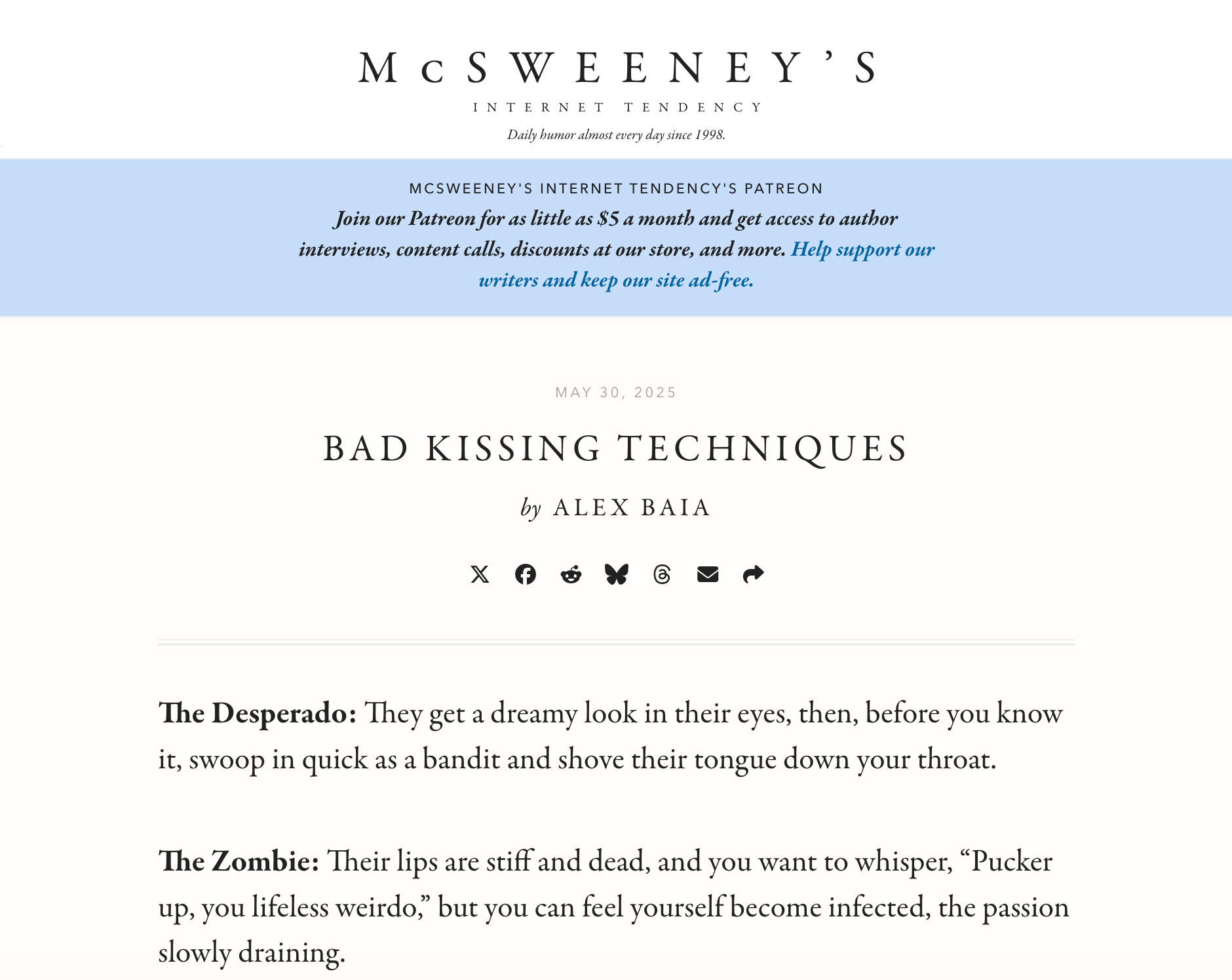
McSweeney’s Internet Tendency article titled "Bad Kissing Techniques" by Alex Baia.
When I promoted a piece I wrote for the New Yorker in my newsletter, I used the same idea. Subject line: “What do you want to do with your life? 🤔.” 63% open rate on that one.
Online comedy piece headlines should have inherent hooks in them, so some of the principles that apply to titling a comedy piece translate reasonably well to writing an email subject line. Keep it short-ish, catchy, and relevant.

The New Yorker article titled "What Do You Want to Do with Your Life?" by Alex Baia.
Admittedly, a lot of this is just by feel and intuition. But it pays to think about your subject lines. Think of yourself as an email scientist and artist, mixed together.
When I do consulting for DTC companies, and I work with them to build a high-converting welcome automation, I’m more scientific about it. I’ll want to do A/B testing, workshop a bunch of different headlines, and discuss the automation in gritty detail. But when it’s my personal list, I do go slightly more by feel. The joys of being an artist!
EmailOctopus has been part of your setup since 2023. What made you choose it initially, and what's kept you here since then?
I was on MailChimp previously, but it got too expensive and cumbersome. MailChimp was originally this kind of fun, light platform, good for indie creators, writers, solopreneurs, etc. Eventually, it just turned into a more expensive, giant platform for big companies and pure eCommerce plays, etc. (Things shifted, from my perspective, shortly after Intuit acquired them in 2021.)
So, I don’t for the life of me remember how I discovered EmailOctopus. But basically, I searched around for email software that was simple and elegant and nice to look at, and not overly complex and not overpriced. But I also wanted it to have flexible, unlimited welcome automations, segmentation, tagging, and all the other stuff that all good email software should have. And I wanted it to have an email composer that was nice to use.
EmailOctopus was clearly the #1 choice. Within a few days of switching, I knew I had made the right choice. Since then, I’ve recommended EmailOctopus many, many times to my audience.
Note to Intuit: If you acquire EmailOctopus and ruin it, I’m declaring a straight-up viking vendetta.
You've built a list of nearly 15,000 subscribers. What's driven that growth? Has any particular lead magnet or similar made a real difference?
It’s been a combination of several things. My single biggest lead magnet over time has been my humor writing cheat sheet. I’ve had easily 6,000 people join my list just because of that. The cheat sheet is a 20-page PDF of advice and tricks to get your humor writing in shape and publish it in good outlets.
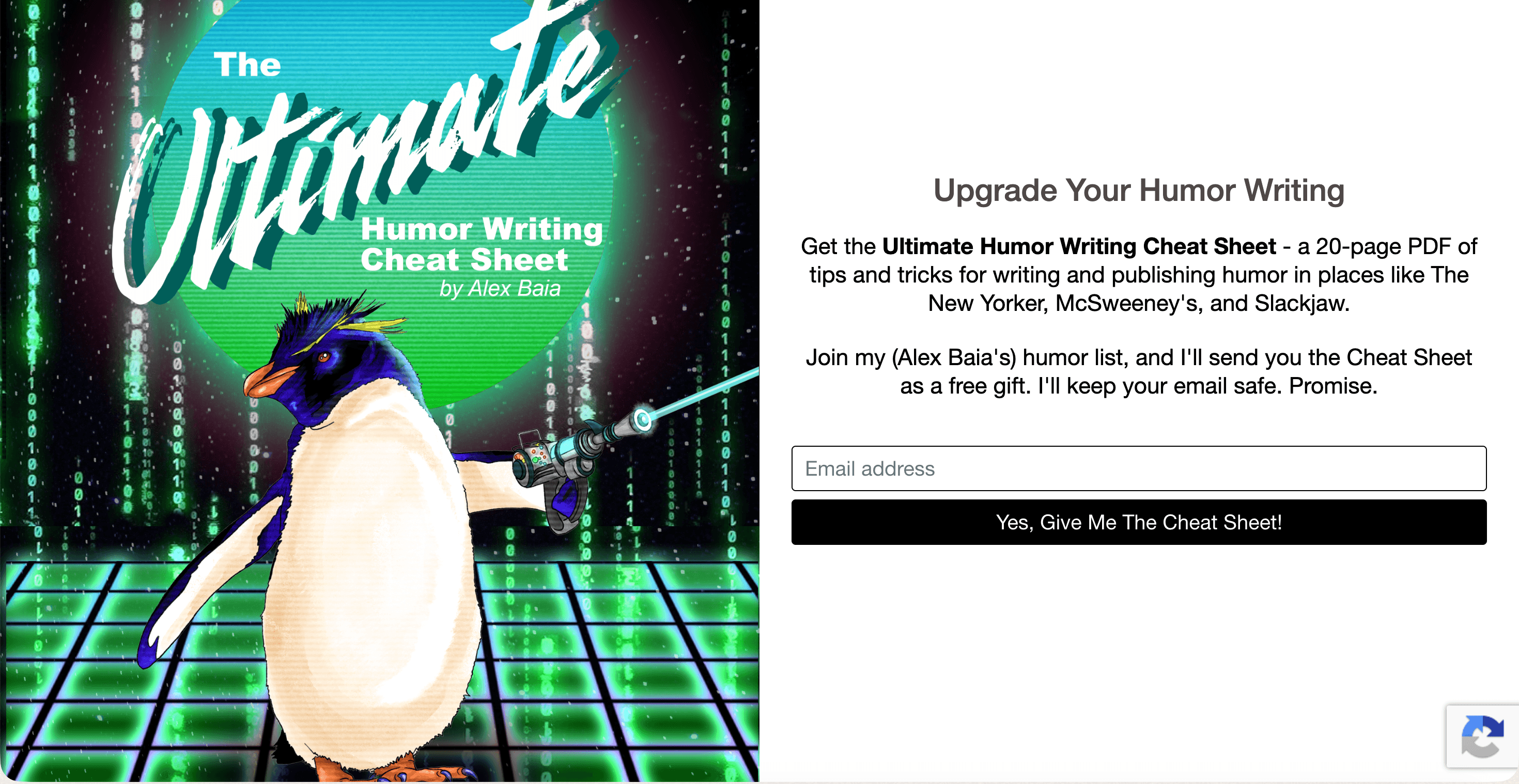
Alex's humour writing cheat sheet landing page.
I’ve also run a number of free writing workshops and challenges over the years, including the “Comedy for All” workshop I’ve co-taught with Scott Dikkers a few times. Each of those has added a few hundred to thousands of people to my list.
And finally, I get some decent organic growth when people read my humor writing or discover my online writing, then pop over to my website and join the list.
I also keep a simple general list signup landing page, linked on my site, just for anyone who wants to keep up with my writing.
These landing pages are all built natively on EmailOctopus, by the way. I highly value being able to quickly whip up a lead magnet landing page. I’m not really a designer, so I go for quick and functional. With EmailOctopus, I can build an opt-in landing page in like 10 minutes.
My advice to writers and creators: Try to come up with at least one lead magnet that entices people to join your list. You could create it once, then set it and forget it. It might generate thousands of leads.
My advice to solopreneurs, businesses, and influencers: try creating a couple of lead magnets (using a free resource), a couple of free webinars that serve your audience or teach them something, and maybe a time-limited challenge or contest. All three of these are time-tested ways to grow a list. All of them work. But you need to test them and iterate to find what works best for your audience growth.
New subscribers get a welcome automation based on where they signed up. Can you walk us through what that actually looks like? What does someone experience in their first few days on your list?
For sure. So, first of all, when I think about a welcome email (or welcome series), I ask: who is signing up, what do they want, and how did they find me? And then I ask: what are my goals when I welcome someone to my list? And what are the best resources I can share with them?
I have a general-purpose welcome automation that works if someone found me through my humor cheat sheet, or just through my general sign up. The automation introduces that person to my comedy writing, and I share some writing resources with them. Because they joined my personal writing list, the goal of the welcome series is to introduce them to me as a writer, my best work, and my resources that could help them write funny stuff.
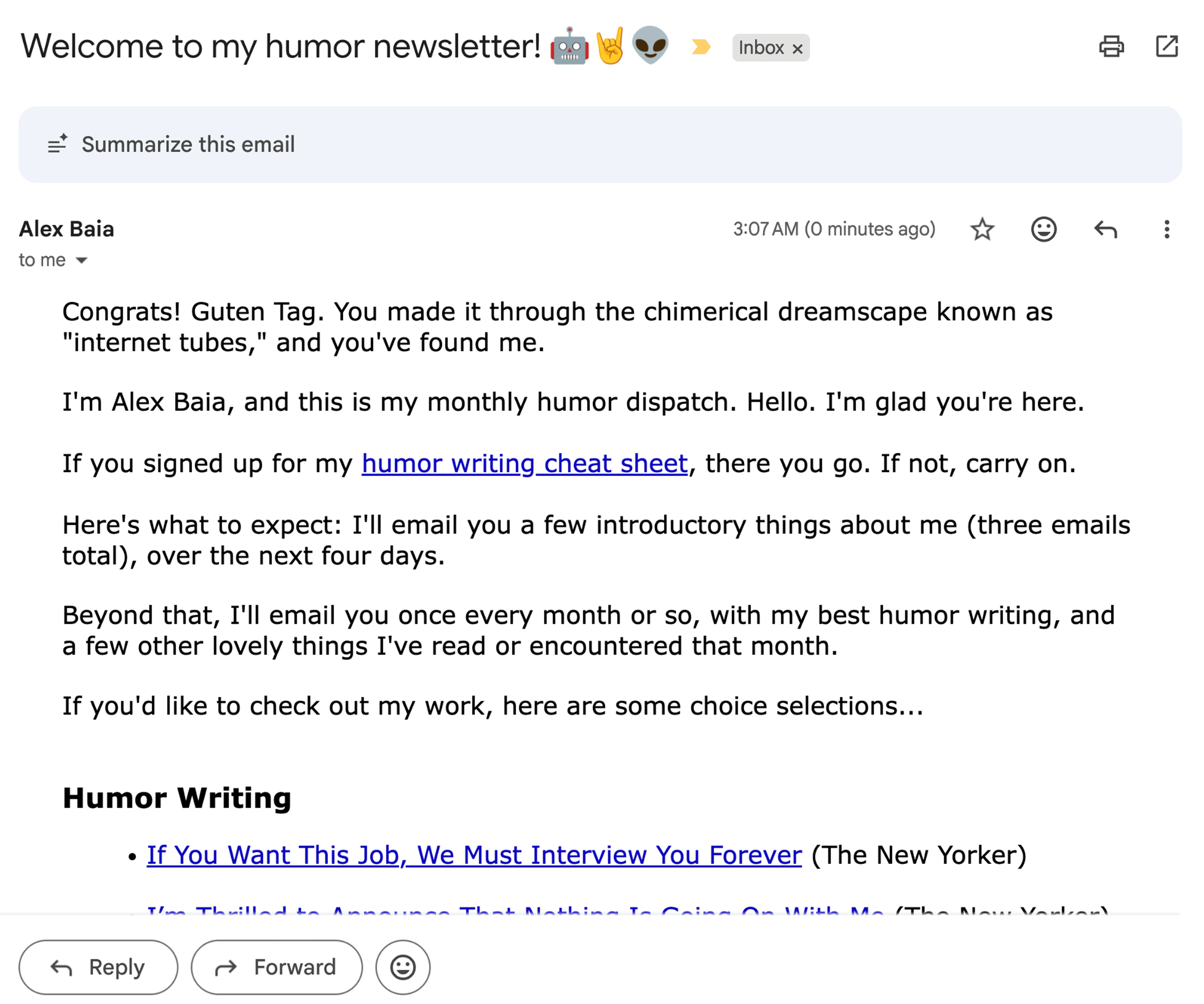
Alex's welcome email.
I also want them to get a feel for my voice. An early sentence in my welcome is “You made it through the chimerical dreamscape known as "internet tubes," and you've found me. Like… what? That’s kind of a loopy thing to write. But I find it personally amusing. So it stays. As marketers and writers, we should be interesting to our audiences, but it helps to first be interesting to ourselves. When someone is bored with their own writing, I can tell. I want to tune out.
Some of your campaigns go to your whole list, others, like Comedy for All and the challenges, etc., go to specific segments. How do you decide who gets what, and has that approach evolved as your list has grown?
My “whole list” campaigns are my general monthly campaigns. These are my regular newsletters where I share new stuff, including my writing. These campaigns go to everyone.
When I segment, it’s typically one of two cases. One, I’m re-sending an email to the segment of people who didn’t open a prior email. Or, two, I’m sending to a special sign-up segment, usually for a writing workshop. A free writing workshop I’m teaching might have, say, 900 people signed up. So, I just email those 900 people who specifically opted in. They’re tagged in EmailOctopus when they sign up, so accomplishing this is trivially easy. It takes 5 seconds.
You often resend to non-openers. What's the thinking behind it, and does it actually work for your audience?
Absolutely. My humor newsletter is not super frequent. It’s like monthly, sometimes even less than that. The open rates vary but are often decent, maybe 50-60%. But still, that’s thousands of people who could’ve enjoyed my beautiful email, but didn’t because they didn’t open it. A lot of non-openers are just busy people who didn’t see the email, or they saw it and meant to open it, but then it got buried, and they forgot.
So, I re-send the exact same email (albeit with a different subject line) about a week later, usually on a different day, and at a different time. The re-send often gets like half the open rate of the original. And keep in mind the re-send only goes out to the fraction that didn’t open the original email.
Example: Say your original email gets a 50% open rate (say, 5K openers out of 10K subscribers), and the re-send gets 25% openers (1,250 open out of the remaining 5K), then you’ve just been opened by 6,250 out of 10K on your list, or 62.5% of the entire list. Nice!
If you’re sending a lot – multiple emails every week – I probably wouldn’t re-send to non-openers. It’s too many emails. But for less frequent senders, it’s an easy hack to increase your readership. Or, you can save your re-sends for your most important emails only.
If you had to pick one thing about your EmailOctopus setup that you'd recommend to other creators, what would it be?
Create a single, default welcome automation that you use to welcome all new subscribers. Then, as you build out other lead magnets or reader segments, you can always recreate the welcome series and tweak it for other purposes (other list segments).
Your welcome sequence is arguably the highest leverage automation you can build for your entire list. Hard to overstate this. Your first welcome email is literally the most opened email you’ll ever write. My general welcome email #1 to my list has an average open rate of 86%. That’s good. Even when I’ve done welcome emails for special purposes like a webinar (where people are flakier, forget things, and often ignore emails), the welcome email #1 still get an open rate of like 60%. Not bad, right?
Welcome emails are also crucial when you’re doing paid lead gen, like running Meta ads (Instagram and Facebook ads) to build your list. Perhaps you’ve enticed them with a freebie or a webinar, but these are new leads that don’t know your deal yet. The welcome series is how you immediately build trust, authority, and familiarity with a new lead who doesn’t know you from a hole in the wall.
If you’re sweating how to get this all done, don’t worry about the details – just create a general-purpose, single, short welcome that goes out to everyone who joins your list. Set it to send right away, as soon as they subscribe. You can always add to the welcome series and create segmentation rules later on.
You can create a single, simple welcome email in EmailOctopus in less than one hour. Start simple. Then make it better later.
Comedy Bizarre, workshops, challenges, consulting and more, you’ve got a lot going on beyond the newsletter. Where do you see your newsletter and the community around it going from here?
I’m a writer who loves to write, so I’ll keep doing that, and I’ll keep sharing my work to my newsletter list. The fun never ends.
In consulting, I’ve often worked with DTC companies, and occasionally solopreneurs or influencers, and I find email growth such a fun, endlessly interesting marketing universe. I’d like to do more projects in the future where I help a brand aggressively grow their list while also building out interesting, effective welcome sequences. I could nerd out about that all day.
I’ll close by pointing to this piece I wrote about email marketing: I Will Teach You to Master Zen Meditation With These Zero Weird Tricks (McSweeney’s).
On a more useful note, here’s a long, in-depth blog post I wrote about growing your list.
Here’s my publication, Comedy Bizarre, where I teach funny writing: https://comedybizarre.substack.com/.
And you can find links to all my work here: https://www.alexbaia.com/.