
Grady Hendrix: a bestselling author on giving readers something in return
Grady Hendrix has built a career that refuses to sit in one lane – horror novelist, film critic, non-fiction author, and co-founder of the New York Asian Film Festival. Across it all, one thing has stayed constant: a mailing list.
He runs three separate lists, each tied to a different part of his work – Paperbacks From Hell, a newsletter built around wild reviews of forgotten horror paperbacks from the '70s and '80s, a decades-old weekly listing of Asian cinema in New York for Subway Cinema, and menu and event updates for his wife's restaurant, Dirt Candy. Each serves a different audience, but Grady treats them the same way: as a direct line to people who actually want to hear from him.
We picked Grady's brain to learn how he balances three very different mailing lists, and why he believes it's the one marketing tool a creator can always rely on.
You've built a career that spans horror novels, film criticism, non-fiction, and co-founding the New York Asian Film Festival. At what point did email become part of how you connect with your audience – and what pushed you to start?
I learned way back that a mailing list is essential because you own it. A social media platform can go bust, taking your followers with it. The press might not cover your event or get your listings wrong. But if you have a mailing list, you will always have a way to directly connect with the people who like what you're doing. Always.

Grady Hendrix – author, journalist, public speaker, film critic, screenwriter, and co-founder of the New York Asian Film Festival.
You run three separate lists, each tied to a very different project. Can you talk a bit about each one? How do you think about keeping those audiences separate, and does your voice change depending on which list you're writing for?
The Subway Cinema mailing list is where it all started. Back in 2000, five of us wanted to save a Chinatown movie theatre that had been showing Hong Kong movies for almost 30 years and was getting put on the market. We failed (it's now a hotel), but we formed a non-profit called Subway Cinema that ran events like the New York Asian Film Festival and a bunch of others. We were the first people to bring directors like Bong Joon-Ho and Park Chan-Wook to American screens, but we were competing with massive, well-financed, sponsor-rich festivals, so we had to put butts in seats and sell tickets. We inherited a listserv from a guy who went by Uncle Prawn that had been sending out a weekly update of all the Asian movies playing in New York City since 1995. We made that the core of the Subway Cinema mailing list, and we still send that update out every week (or every other week), 31 years later (the list has fully opted in since). We also do giveaways at every screening, and people can use the giveaway form to sign up for the mailing list.
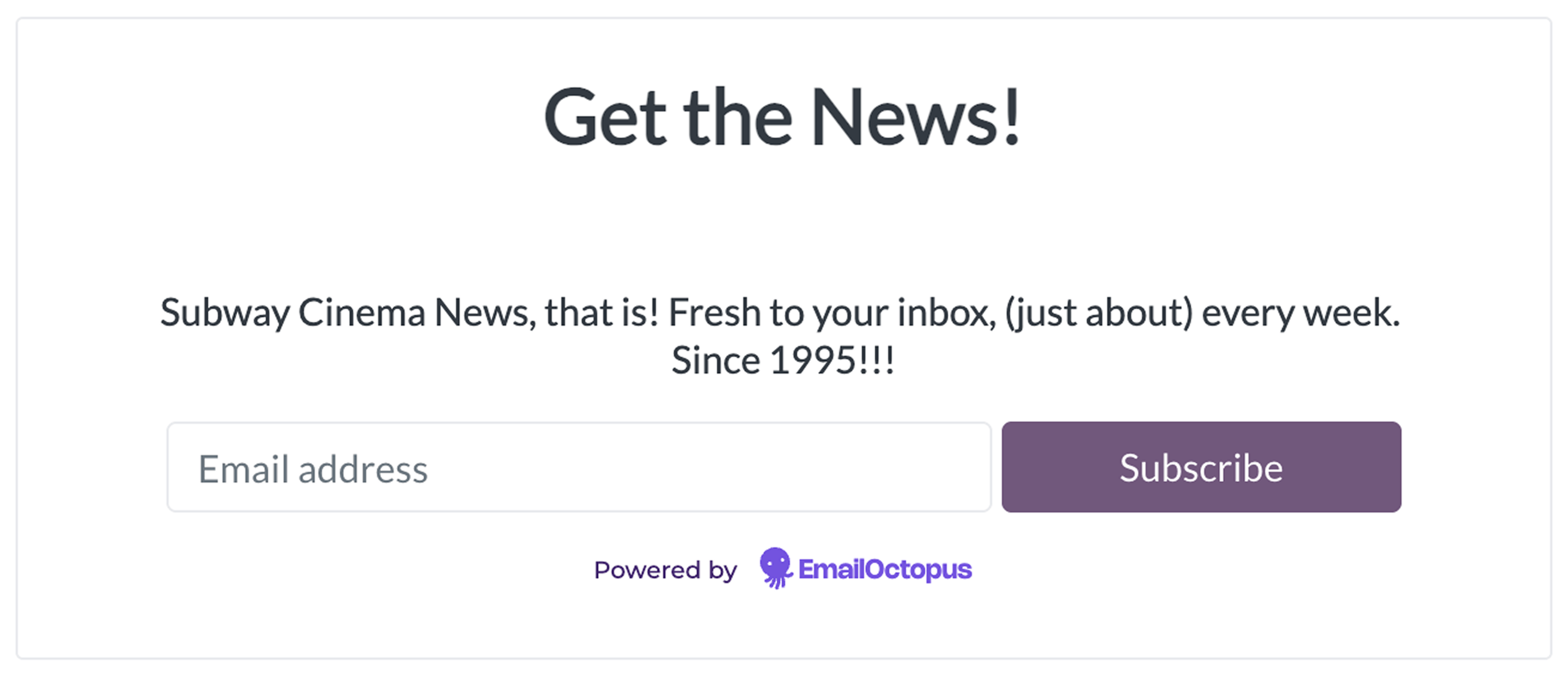
Subway Cinema's sign-up form.
By the time my wife opened her vegetable restaurant, Dirt Candy, I knew how important mailing lists were. We used an in-house sign-up form that came with the check and an online sign-up, and we built that mailing list into a powerhouse. Even though the press often ignored her restaurant (despite having a Michelin star, if you're a woman and you don't serve meat, you're not considered a "real" restaurant), that mailing list kept us alive. She used to do tons of special events, and we could sell them out through the mailing list alone. Even today, she changes the menu four times a year, and when we sent out the newsletter about the new menu, we saw a huge jump in reservations.
When I started writing books, having a mailing list was not even a consideration. I knew that if I wanted to connect with readers, that was the best way to reach them.
How do you decide what goes into each newsletter? Do you have a rough format you stick to, or does it vary?
The Dirt Candy list is the one I have the least control over, and these days it's really used only to announce menu changes and special, ticketed events. My wife and I realized that restaurants spam our inboxes, so it made sense to chill out with our mailing list after Dirt Candy got established. These days, we only bug people when we absolutely have to.
The Subway Cinema newsletter is a weekly (or bi-weekly) listing of all the Asian movies playing in NYC, but if we're doing an event that week, we list it first. This newsletter is a lot of work, and we don't have our own events every week, but we think it serves a purpose, and we believe it matters. Our audience trusts us not to sell their data and to provide them with a service, and we take that seriously.
Author newsletters are really self-serving – that's the nature of the beast, but I wanted to offer something different, so I call mine Paperbacks from Hell. I wrote a book a while back called Paperbacks From Hell that was a history of the horror paperback boom of the '70s and '80s, so every PBFH newsletter is a wild review of some bonkers horror paperback from back then. When I have book events or a new book on sale, I list it, too, but the focus is on the weird paperbacks – I've written about were-unicorns with insatiable sexual appetites (The Jade Unicorn, 1979), werewolf baseball players (Southpaw, 1988), and haunted three-piece suits (The Suiting, 1988). I'm about to send the 100th newsletter, and it's focusing on jogging horror, which was a big thing in the late '70s, believe it or not.
%2520(1)%25201%2520(1).png&w=3840&q=100)
A snapshot of the Paperbacks From Hell newsletter – Grady's wild reviews of forgotten horror paperbacks, one issue at a time. This is issue #95, on The Suiting by Kelley Wilde.
Have you noticed differences in how each audience responds to your emails?
These are long-term commitments – writing about weird horror paperbacks, listing all the Asian movies playing in NYC – but when the time comes to promote something of our own, we absolutely see a jump in ticket sales or book pre-orders. The Paperbacks from Hell list is more volatile than the others, and I can only assume that's because some people sign up just because they want to know when my next book comes out, and they don't want reviews of killer doll books showing up in their inboxes.
What's the most memorable moment email has directly created for you – a reader response, a book launch spike, something you didn't expect?
I think that the very first Dirt Candy newsletter changed our lives. My wife and I (but especially my wife) went way out on a limb to open DC back in 2007, and the only press she got was articles making fun of the restaurant's name, voting it "Worst Restaurant Name in NYC". We'd been slowly building up a mailing list while the place was under construction, and I remember sending the first email telling people we were open, and the reservations just exploded overnight. I mean, people booked it so fast it wasn't even funny. That's when we realized that a big social media presence was nice, good press was flattering, advertising was useful, but a mailing list was essential.
Your books range from haunted IKEA-esque stores to a history of pulp horror paperbacks. Do you find that the more niche or unusual the subject, the more engaged the list tends to be?
The Subway Cinema Newsletter has the most consistent click-through rate. Week in, week out, we've got a good, reliable bunch of readers who use it to buy tickets. We don't make any money off that. For us, it's a public service and a loss-leader to promote our own events when we have them, so it's worth it.
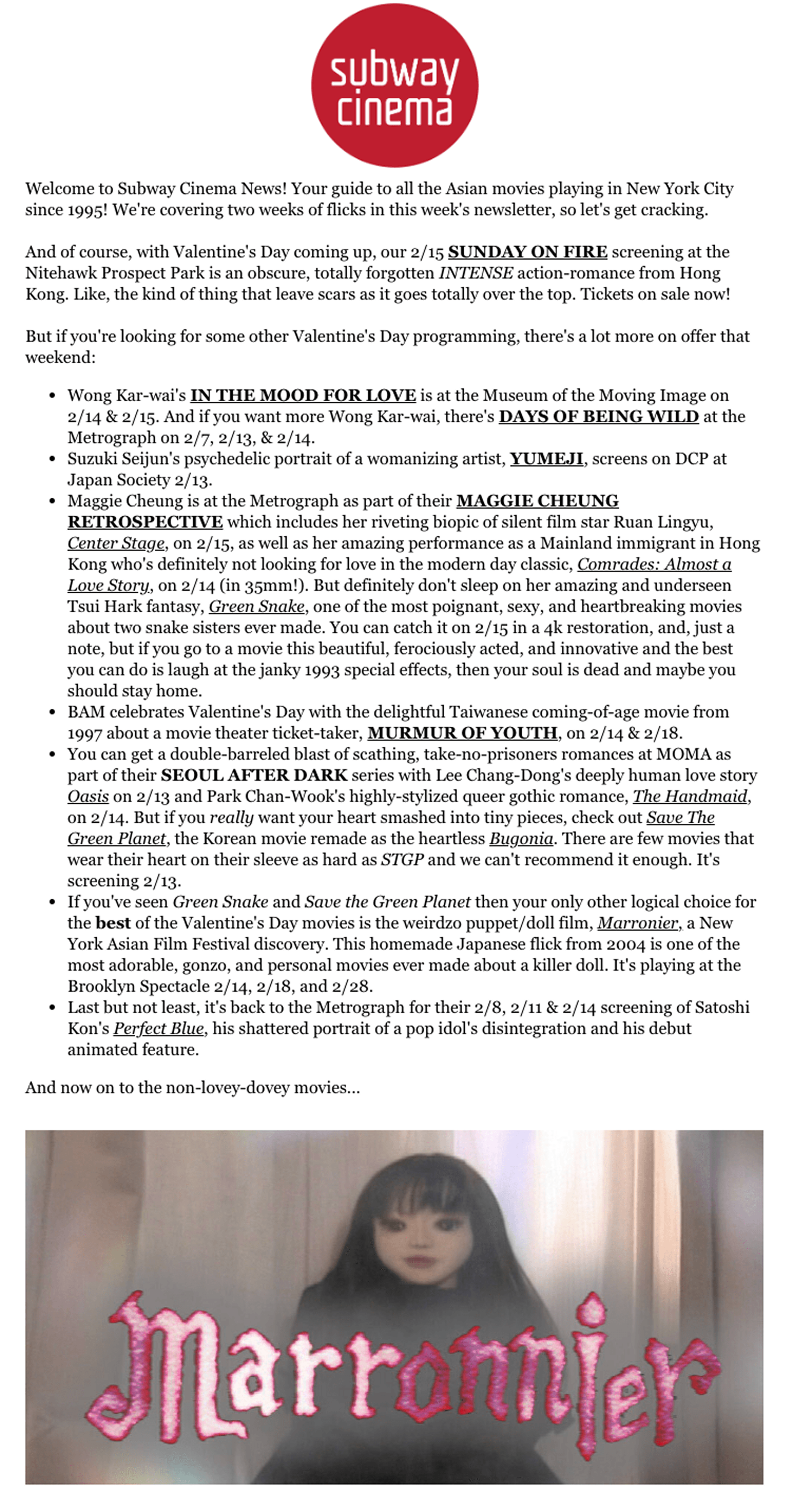
A snapshot of the Subway Cinema News newsletter – Grady's weekly guide to Asian cinema in New York City, running since 1995.
You write some of the best titles in the genre. Do those instincts carry over into how you write subject lines?
I am terrible at writing subject lines. I think there's an art to them, and I haven't mastered it yet. I tend to write funny, and funny subject lines do worse than informative subject lines. I'm learning.
How do you think about growing your lists – is it something you actively work at, or does it happen organically?
It becomes a habit. In fact, you can get in a rut where you do the same thing over and over again (collecting sign-ups at events, giving a sign-up form with the check), so every now and then I have to kick myself in the butt and try something different, and the results are always worth it.
How has EmailOctopus made managing all of this easier? And what made you choose it in the first place?
I used Mad Mimi for decades because it was barebones. When it closed, I went looking for a platform but was depressed and overwhelmed to find that so many of them were about squeezing revenue out of readers, managing ads, harvesting data, and now so many of them are powered by AI products. I had three mailing lists with years of history behind them. I believed in using them as promotional tools, not as revenue generators. EmailOctopus was the only place I found that let me just do emails, track them, and manage my mailing list.
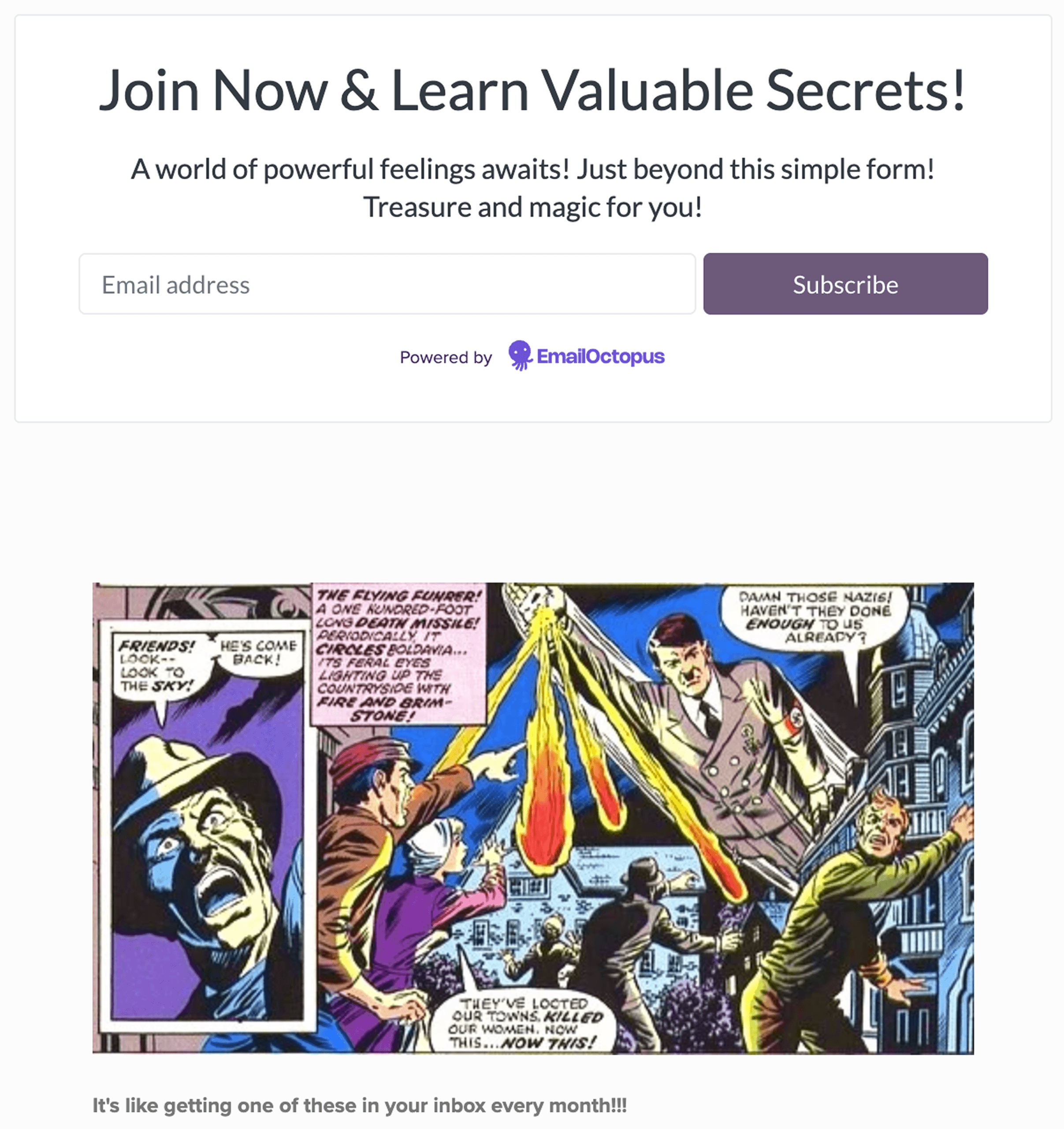
The Paperbacks From Hell's sign-up form.
What's the biggest mistake you see authors make with email marketing?
You have to offer your readers something beyond "Buy my new book!" or "Look how cute I am!" You need to give them something funny, or useful, or entertaining — they need a reason to click. My Paperbacks from Hell newsletter is designed to give you a laugh in the middle of your day. So if you're just starting out, that's what I recommend: find a way to offer readers something of value that's not all about you.
Is there anything you'd like to do differently with your email setup going forward – new projects, new formats, anything brewing?
I just wish I could be more consistent. As long as I've been doing this, it's easy to fall into the trap of missing an email, or skipping a week, or phoning it in. Consistency is key. There are no shortcuts.
Thanks!
Check out Grady's website and subscribe to his newsletters: Paperbacks From Hell, Subway Cinema, and Dirt Candy.
-1.png&w=3840&q=100)